Qatar’s Energy Proposal for Lebanon: A Reform Test, Not Just a Supply Deal
Qatar’s proposed investment in Lebanon’s electricity sector presents opportunities for power generation, gas infrastructure and regional energy connectivity. Its implementation, however, will depend on financing arrangements, institutional reforms and the management of political and operational risks. This Insight examines the strategic and economic implications of Qatar’s energy proposal for Lebanon, focusing on investment opportunities, regional energy connectivity, and the financial and institutional challenges that could shape its implementation.
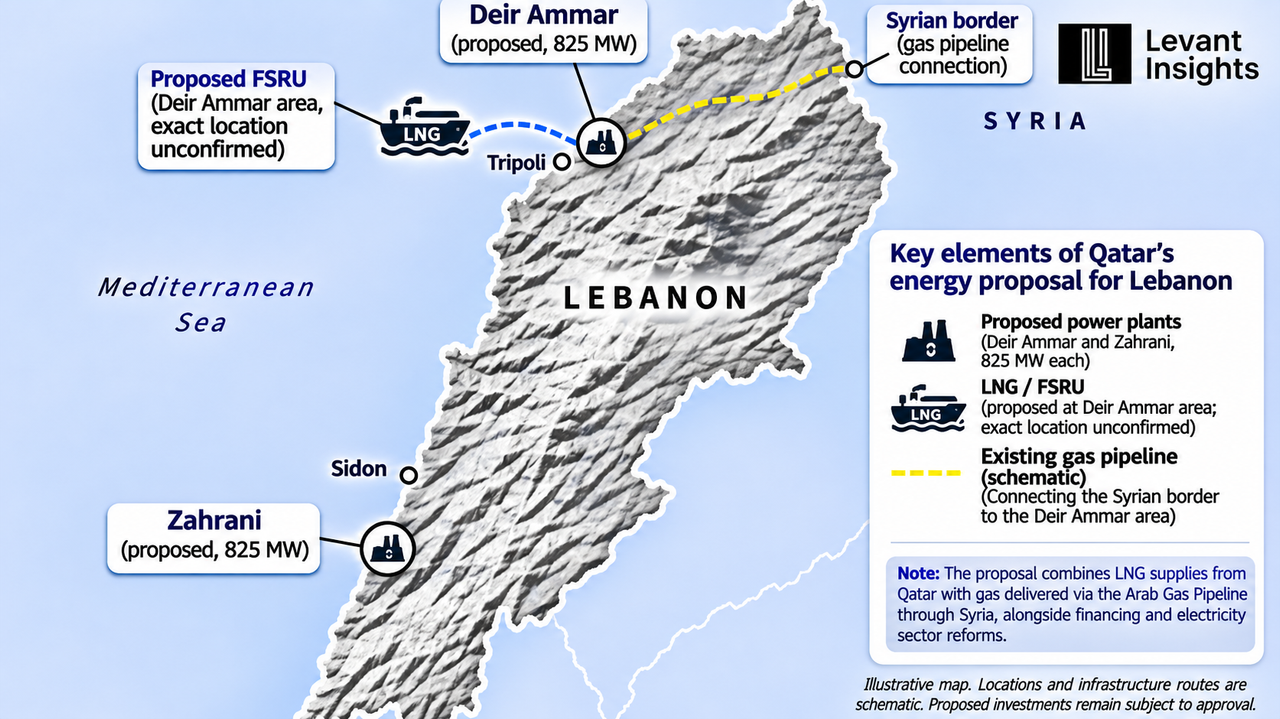
A Qatari-backed proposal to build two power plants and supply Lebanon with LNG for 20 years could be the most concrete attempt in years to address the country’s electricity crisis. For now, however, the programme remains a draft, and its eventual success will depend not only on investment and fuel supply, but also on Lebanon’s ability to address persistent problems in electricity-sector governance, revenue collection and payment security..
Lebanon’s electricity sector has long been a source of fiscal strain without delivering reliable service. State power is available only a few hours a day, and households and businesses depend on costly private diesel generators.
Against this background, a Qatari-backed proposal, outlined in an October 2026 draft titled the National Integrated Energy Investment Program, offers a potential path to expanding electricity generation capacity and securing long-term fuel supply.
The Proposal: What Is on the Table
Generation and Fuel Supply
According to the October draft, the programme envisages two combined-cycle power plants, one in the north at Deir Ammar and one in the south at Zahrani, each with a capacity of 825 MW. The implementation timeframe is three years, if approvals come swiftly.
The proposal also provides for a 20-year LNG supply agreement with QatarEnergy, supported by a floating storage and regasification unit with a capacity of 3.5 million cubic metres per day. Gas could also be supplied through the Arab Gas Pipeline via Syria, with a capacity of 4.5 million cubic metres per day. Other elements include renewable energy, battery storage and regional electricity connections.
Financing: The Unresolved Core
The draft aims to attract private investment and project financing without requiring upfront spending from Lebanon’s public budget. However, payment obligations and guarantees remain subject to negotiation. How these arrangements are structured will be important in determining whether the programme can secure financing and move forward.
Status of negotiations
The proposal has since advanced into negotiations, although no final agreement has been reached. On 30 October, Lebanon’s Ministry of Energy and Water confirmed that three rounds of talks with Qatar had addressed the programme’s legal, commercial, financial and technical aspects. A fourth round was planned to work towards a letter of intent, which would then be submitted to the Lebanese Cabinet for approval. On 5 November, LBCI reported that further electricity-sector discussions had moved from Beirut to Doha. The programme therefore remains under negotiation rather than an approved investment commitment.
The Reform and Implementation test
In our assessment, the decisive question is not simply whether Qatar can supply gas and build plants, but whether Lebanon can turn this investment into a reliable and financially sustainable electricity supply. Past reform efforts in the sector have faltered amid political disputes, and the same pressure points are likely to determine whether first gas becomes sustained power.
Cost Recovery and Tariffs
New capacity only improves service if the state utility can collect enough revenue to pay for fuel and operations. Without tariff and collection reform, additional generation risks reproducing the arrears that have limited supply in the past.
Utility Governance
Plants, a regasification unit and interconnections require an operator capable of dispatching power, managing contracts and enforcing payment. Governance of the state utility will therefore shape project bankability as much as the technology does.
Payment Guarantees
Because the draft avoids public capital expenditure, lenders and suppliers will look to guarantees and payment security. How these are structured, and who stands behind them, will indicate how much risk Lebanon retains over the 20-year term.
Supply Route Dependencies
Combining an FSRU with the Arab Gas Pipeline diversifies delivery options, but the pipeline route depends on conditions in Syria, where territorial control remains fragmented. Whether the LNG leg is destination-flexible or tied to Lebanon will also matter to its commercial terms.
The Energy Programme and Qatar’s Evolving Role in Lebanon
Building on Existing Energy Ties
Qatar is not a new actor in Lebanon’s energy sector. QatarEnergy entered Lebanon's offshore exploration sector in 2023, acquiring a 30% stake in Blocks 4 and 9 alongside TotalEnergies and Eni. Both blocks have since been relinquished, while the consortium secured an exploration permit for Block 8 in January 2026. Doha has also reportedly announced an approximately $434 million support package in January 2026, primarily for energy.
A long-term generation and supply package would deepen Qatar's involvement in Lebanon's energy sector. If agreed and implemented, the proposed 20-year LNG arrangement would establish a sustained commercial relationship between QatarEnergy and Lebanon.
The Political Significance of Qatar's Involvement
Beyond the financial and commercial aspects, a long-term role in the electricity sector could also strengthen Qatar's political position in Lebanon.
Electricity is a highly visible public service, and persistent shortages affect the daily lives of Lebanese citizens. If the programme delivers tangible improvements, Qatar could gain political credibility and goodwill by contributing to the resolution of one of the country's most persistent problems.
Electricity is also a strategically important sector, closely connected to the functioning of the state and the wider economy. Sustained involvement in its supply and generation would give Doha a stake in the stability of the state's core functions, not only in the success of a single project. A long-term partnership could also provide opportunities for political influence through continued engagement with Lebanese authorities over tariffs, payment guarantees and sector governance.
Qatar's established diplomatic relationships could reinforce this role. Doha helped broker the 2008 agreement between Lebanese political factions and has more recently participated in the Quint Committee's diplomatic efforts. Combined with its long-term energy commitments, these relationships could allow Qatar to support political continuity around the programme. In this sense, Doha could become a political anchor, although its ability to exercise influence or facilitate reforms would remain dependent on Lebanon's domestic political dynamics.
Implications for Business
Assessing the Opportunity: Commercial and Geopolitical Considerations
Contractors, equipment suppliers, financiers and advisers could find opportunities in plant construction, regasification, grid upgrades, renewables and storage, but only once approvals and financing are confirmed. Companies should assess their exposure to the state utility and the strength of any guarantee structure before committing capital or supply. The three-year timeline assumes swift approvals, so, given the history of draft electricity plans in Lebanon, businesses should plan for delays and distinguish between a signed agreement and first gas. Energy pricing, shipping conditions and security developments across the Eastern Mediterranean and the Gulf will also affect both costs and the pace of investment decisions.
Geopolitically, the project’s viability also depends on Qatar’s continued willingness and capacity to commit, which is tied to regional security conditions in the Gulf, as well as on Lebanon’s own political stability. Businesses should therefore monitor both Doha’s priorities and Lebanese domestic developments, since either could change the pace or scope of the programme.
Effects on Operating Conditions for Other Businesses
More reliable electricity could change operating conditions well beyond the companies directly involved. Many firms currently rely on private generators and diesel to fill gaps in state supply, so a more stable grid could lower energy costs, reduce production interruptions and make planning easier, particularly for energy-intensive sectors such as manufacturing, food processing, cold storage and hospitality. These gains would depend on the plants being built, fuel being supplied reliably, and grid and tariff reforms keeping the system financially sustainable. Businesses should treat improved supply as a possible medium-term benefit, not a basis for near-term planning.
Implications for Investment Confidence
Qatar's involvement could have implications for Lebanon's investment environment beyond the electricity sector. As discussed above, a long-term commitment to energy infrastructure could strengthen Doha's economic and political position in the country. For investors, this could provide an additional indication of Gulf interest in Lebanon and potentially encourage engagement in other sectors.
However, Qatar's involvement should not be interpreted as a broader guarantee of political or economic stability. Investor confidence will continue to depend on institutional reforms, financial-sector conditions and the security environment. Much will also depend on whether the proposed programme progresses from political commitment to implementation, and whether it creates conditions for further investment.
Conclusion
The Qatari-backed proposal is significant because it brings together electricity generation, fuel supply and financing in a single programme. Successful implementation could improve Lebanon's electricity supply, reduce operating costs for businesses and create opportunities for further investment. Qatar's sustained involvement could also support the programme's political continuity. Yet the proposal remains a draft, and its success will depend on Lebanon's capacity to address longstanding weaknesses in electricity-sector governance and financial sustainability. For businesses and investors, the key signals to monitor are government approvals, the structure of payment guarantees, and progress on tariffs and utility governance.